
One Choice Away
How small decisions around alcohol, tobacco, and habits can reshape your long-term health


“The distance between who you are and who you want to be is just one choice away”
- The Priory Group
The Substances Pillar - What is it really about?
When people hear the word “substances,” they often think in extremes: addiction, dependency, crisis, or complete abstinence. In lifestyle medicine, however, this pillar is broader, more human, and far more everyday than that. Whether it is social drinking at the pub, a daily fix of caffeine or endless scrolling, pretty much all of us have a vice of some sort. Lifestyle medicine recognises that risk exists on a spectrum - the gold standard health approach being avoidance of toxic substances and behaviours, but if none is not a realistic option, then less is generally better. That’s why its full name is Minimisation of Harmful Substances pillar.
This pillar is ultimately about freedom rather than restriction. Freedom from autopilot. Freedom from shame or guilt around our behaviours. Freedom from habits that quietly tax your future self. What all the substances have in common is that they are addictive - they are designed to hook you, engineered to make your body and mind crave more. The everyday caffeine fix is a helpful way to understand this concept. Caffeine blocks adenosine receptors in the brain, so regular use triggers the body to produce more receptors which makes the same amount of caffeine less effective over time. That means you may need more caffeine to get the same alerting effect.1
Beyond Substances: The Pull of Habit
Underlying this pillar is not the substances themselves, but something more fundamental: our behaviour towards them. The drink reached for when stressed, anxious, or low. The cigarette that marks the end of a working day. The extra glass poured because everyone else is still drinking. The 5 mins of social media scrolling that turns to 50 mins, or that free sports bet that turns into a habit. In this sense, the substance pillar also reaches into the digital realm, addressing behavioural addictions such as gambling and compulsive screen time, social media or internet use.
At its heart, this pillar asks a simple but searching question: are the things you consume, and the behaviours you engage in, helping you become the person you want to be - or are they quietly pulling you away from that version of yourself?2
Can you reverse the damage?
Yes…and no…The unfortunate truth is that there is no healthy limit for any of the substances, but there are ways to reduce the risk and there are always benefits after you stop.
Take alcohol, the UK recommendations are to drink no more than 14 units of alcohol per week.3 The reality though, as stated by the World Health Organisation, is even one glass carries some risk.4 Alcohol is classed as a group 1 carcinogen – sitting in the same category as tobacco smoking and asbestos.
The encouraging truth is that it is never too late to make behavioural changes. The body has a remarkable ability to recover once exposure to harmful substances is reduced or stopped. After quitting smoking, circulation begins to improve within weeks, breathing often improves over months, and long-term risks continue to fall over time. In contrast, it is estimated that on average, smokers in Britain who do not quit lose approximately 20 minutes of life expectancy for each cigarette they smoke.5
Reducing alcohol intake can improve sleep, energy, blood pressure, liver health, and overall wellbeing, and may also support better mood and weight management. The NHS reports that alcoholic fatty liver disease is reversible if a person stops drinking alcohol for months or years.6 Not everything is instantly reversible, and some damage can be lasting - but far more is recoverable than many people realise and it is rarely too late to benefit in some form.
Willpower is overrated, think in systems
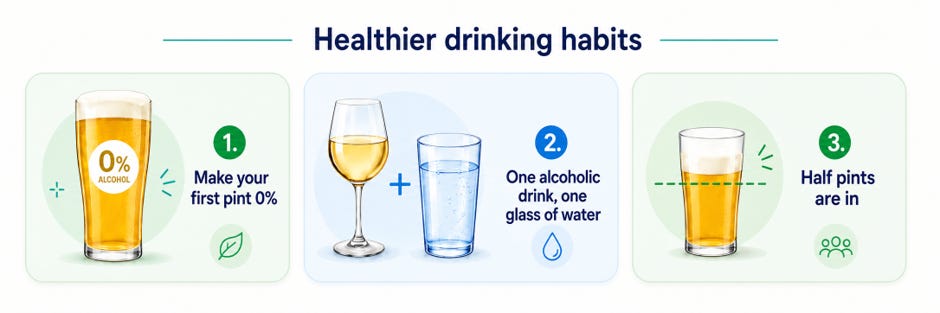
We’ve all been there. Promising ourselves this is our last cigarette, that we’d stop after the next drink but then it becomes too tempting. What we can do is introduce a system that embeds minimising substances. Let’s keep with alcohol. Next time you’re at the pub, make your first order 0%. Maybe order a glass of water with each drink. Or order half pints and keep your beer cold.
Summary
You do not need to change it all today.
Just notice where your habits gently lead.
Let one small thought take root along the way,
Then grow into one honest choice, one seed.
And when you’re ready, choose again -
Not all at once, but now and then.
Disclaimer: This content is for educational and informational purposes only and is not intended as a substitute for professional medical advice, diagnosis, or treatment.
Resources:
Dow, C. (2021) ‘Is Caffeine Helping or Harming Your Health’, Center for Science in public Interest. Available at: cspi.org.uk (Accessed: 28 June 2026)
British Society of Lifestyle Medicine (n.d.) Harmful Substances. Available at: https://bslm.org.uk/harmful-substances/ (Accessed: 27 June 2026).
Alcohol Units, NHS. Available at: https://www.nhs.uk/live-well/alcohol-advice/calculating-alcohol-units/ (Accessed: 28 June 2026)
No level of alcohol consumption is safe for our health, (2023) World Health Organisation. Available at: https://www.who.int/europe/news/item/04-01-2023-no-level-of-alcohol-consumption-is-safe-for-our-health (Accessed: 28 June 2026)
Jackson, S.E., Jarvis, M.J. and West, R. (2024) ‘The price of a cigarette: 20 minutes of life?’, Addiction. Available at: doi.org
NHS (n.d.) Alcohol-related liver disease. Available at: https://www.nhs.uk/conditions/alcohol-related-liver-disease-arld/ (Accessed: 29 June 2026).
 | A guest post by
|